

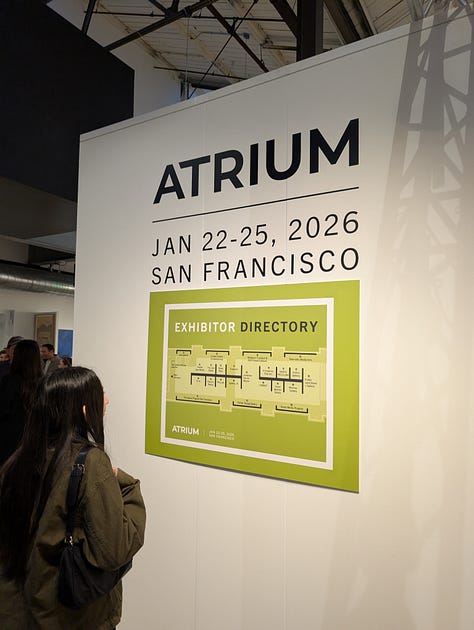
Early Thursday afternoon, arriving much too early for the inaugural ATRIUM art fair, I somehow talked my way into di Rosa San Francisco before it officially opened. Inside di Rosa was an exhibition by Tiffany Shlain and Ken Goldberg, layered tree rings tracing stories of human time. It was my first time at any di Rosa, coming just a day after news that they were putting their 217-acre Napa campus up for sale for $10.9 million to shore up finances and safeguard its renowned collection of Northern California art. Later that day, Shlain warmly introduced herself, then looked askance when I mentioned my premature peek. There had been a hard dictate, it turned out: no early entry. The realization landed belatedly, and a little hot. My first blush at the threshold of ATRIUM.
Late Monday night, the curling, coiled steel cables of the Bay Bridge swooped me into San Francisco for its annual art week, a flourish of openings, parties, performances, talks, and art fairs, all huddling around the fiscal warmth of FOG Design+Art, a smallish but blue-chippish international art fair launched in 2014 and held at the Fort Mason Center, Pier 2 and 3.
A few days before my arrival, the president of the California College of the Arts announced the last private, nonprofit art college in the Bay was shuttering after 120 years, preceded in death by the august and beloved San Francisco Art Institute back in 2022. CCA isn’t exactly dying the way SFAI did, but rather being purchased by Vanderbilt University in the same way that local Mills College was inhaled to become the westernmost campus of Northeastern University. The Wattis Institute will remain for now, but everyone else who works there—artists, critics, technicians, support staff—is mostly expecting to be turfed out. And all this not long after the closure of many beloved galleries, including Altman Siegel, one of the very best in the Bay, and steps away from di Rosa SF.
With the SF doom loop allegedly all looped out by the hot flush of AI money and the cheerful boosterism of Mayor Daniel Lurie of the billionaire Levi Strauss & Co. dynasty, this news stutters the civic exuberance. Announcing CCA’s closure right before art week felt—well, a little cruel. There are two emerging disruptophile, boutique alternatives for the future of art education in the Bay: non-degree-granting apprenticeship/residency programs, one called Art + Water in Fort Mason, spearheaded by author Dave Eggers, and another from heiress Laurene Powell Jobs, built on the bones of SFAI. Even with these green shoots, a forest is still being clear-cut. The ecology necessary to sustain a healthy art world—museums, nonprofits, commercial galleries, schools, and art criticism—just lost another of its fundamentals.
This is the soil that ATRIUM is growing out of.
After my own labor for the week—an exhibition I helped curate for the Shack15 Art Award—and having passed other fanfares and art fairs, I arrived early for ATRIUM at the Minnesota Street Project.
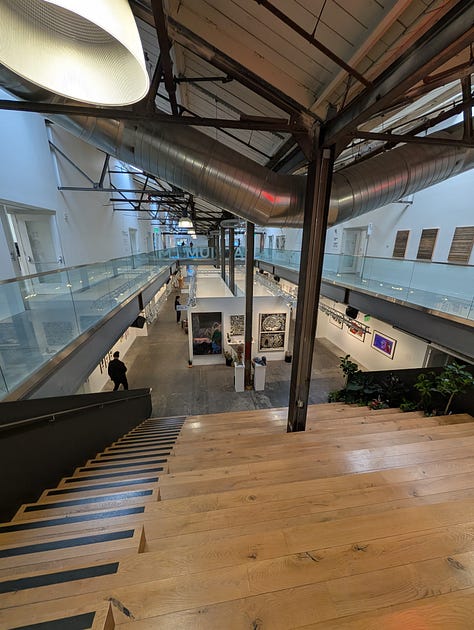
Founded in 2016 by collectors and philanthropists Andy and Deborah Rappaport in response to catastrophic real-estate pressure on the Bay art scene, Minnesota Street Project is a rather large, privately initiated arts complex in San Francisco’s Dogpatch, cinching commercial galleries, artist studios, and nonprofits together across a cluster of buildings. The Dogpatch feels like one of those post-industrial schemes where old factories and warehouses are converted into tech office space, plugged here and there with condos. Wryness aside, I am actually and genuinely grateful that one of the Bay overlords did something substantively civic to help a pummeled art world survive here.
Organized by MSP with gallerist Eleanor Harwood leading the selection committee alongside Aaron Harbour of Et al. and MSP's Jonathan Runcio, ATRIUM is a new Bay-focused art fair staged across MSP's campus. Free and open to the public, it was conceived as a local, low-barrier, and wildly more democratic alternative to FOG's international blue chip model, using MSP's existing infrastructure to fold temporary fair booths into the site's year-round galleries, nonprofits, and artist studios.
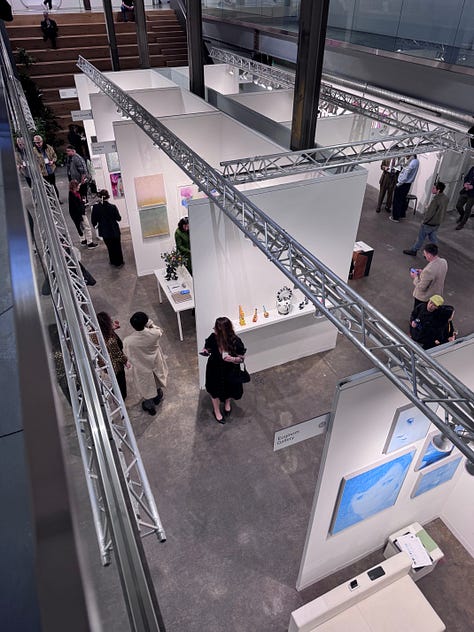
Past a sushi truck and a petite café, MSP opens into its large central atrium where the fair unfolds, flanked on two stories by the regular galleries that live there. Art-fair booths stretch down that atrium, more snug than the usual, but somehow sweeter. Tacked onto both the resident and visiting galleries is a kind of sub-fair of artist-run spaces in one of the larger, winding upstairs corner galleries, with a skylight. Following the naming conventions of ATRIUM, this has been dubbed Skylight Above. The model, strikingly summoned from its open-space architecture, folded gently and easily into the existing framework, an amendment that allowed many not based at MSP into one shared space.
Alongside the 13 MSP exhibition spaces were another 24 visiting galleries and 13 artist-run projects for Skylight Above. Of these 50, six came from outside the Bay: one from Cambria, one from Santa Barbara, and four from Los Angeles.
It was a resolutely locavore affair, with a half dozen invitees from down the coast. I use locavore thoughtfully. ATRIUM has the approachability and pleasure of a local food festival, a Taste of San Francisco. The flicker and buzz, the friends well met crowding the narrow aisles. The gallerists aflutter in the booths, with paintings and sundry wall works both well hung and also more casually leaning against the walls on the ground.
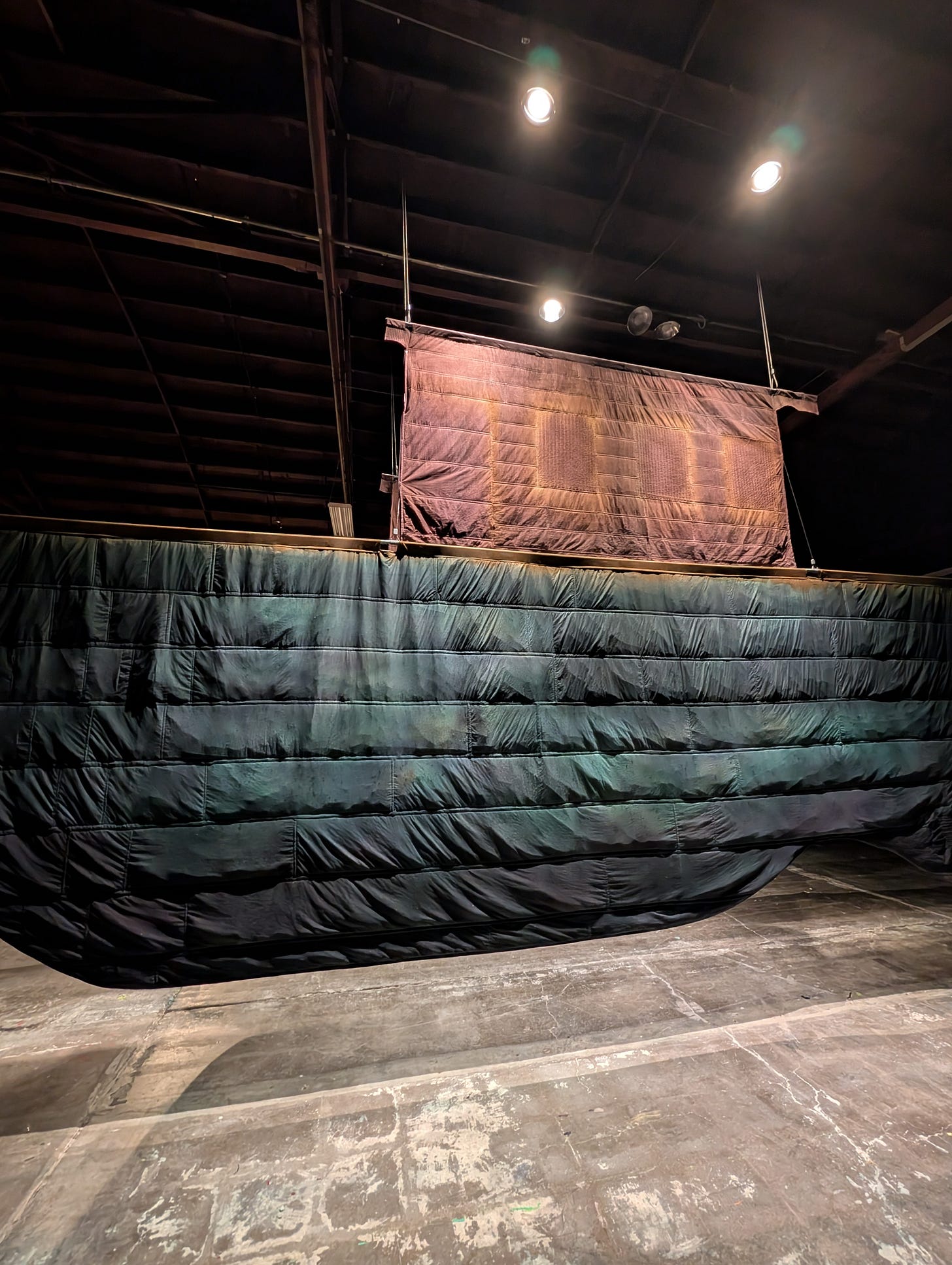
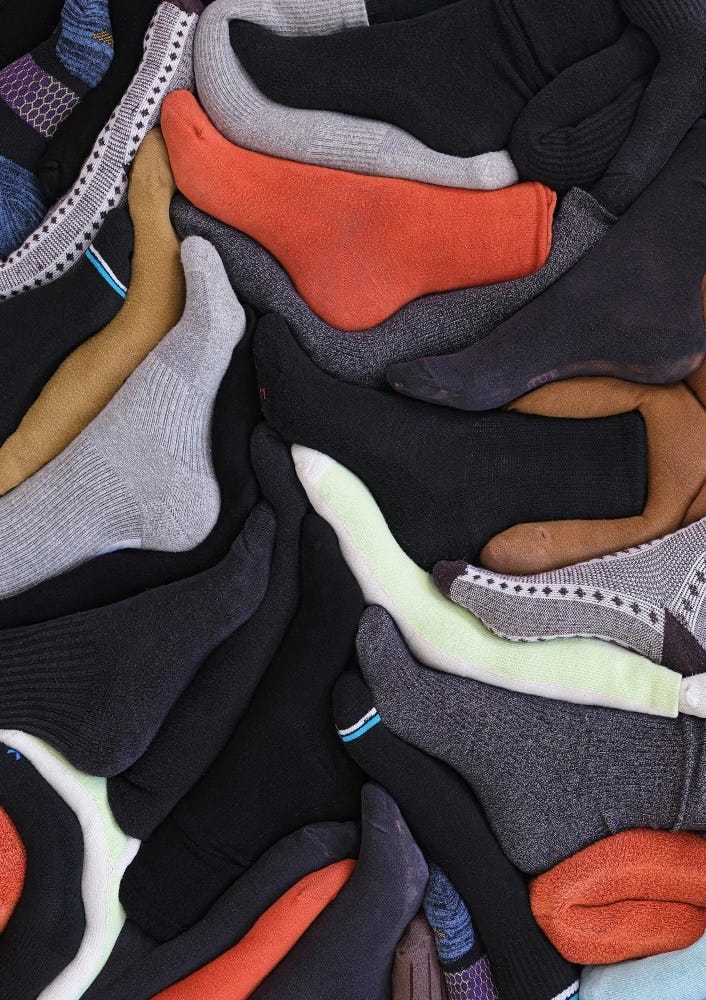
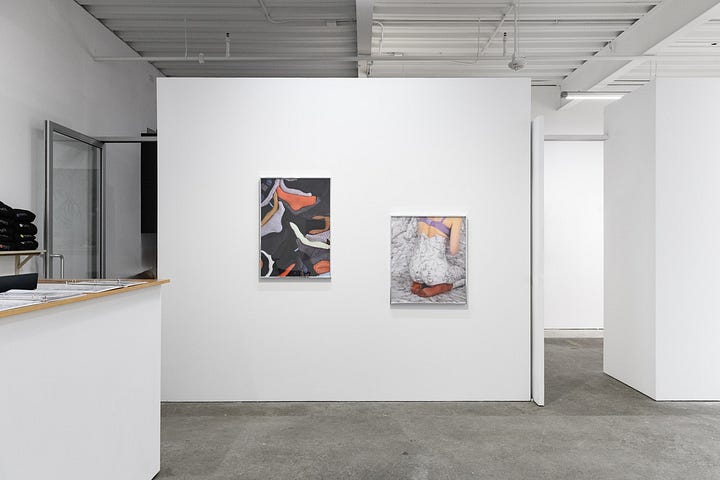
While circling MSP’s campus, I saw the quilted billows in the cavernous MSP Foundation space by mother-son artist collaboration May and Mik Gaspay, silhouettes of the boats that carried their family displaced from Vietnam. At Eleanor Harwood, I spotted huddled socks and camouflaged constructions drawn from the everyday of the artist, snapshotted and sculpted by Lee Materazzi.
Together, these works shared a seriousness scaled to the human, attentive rather than spectacular, confident without theatrics.
Art isn't cheap per se, but many of the price sheets I peeked at felt downright achievable. Modest enough for this penniless poet to nearly blow $400 at Bass & Reiner on gorgeous reworked stereographs by Sally Scopa. Those double-imaged cards you'd slip into a stereoscope for a three-dimensional image, in Scopa's hands, become subtle, lyrically cosmic abstractions. Each retains the structure of the card and its markings, which in a handful contain descriptions like terse poems of lost—or perhaps re-dreamt—pictures: "84. Jungfrau of the Swiss Alps," "Winter, Landscape," "101 An Approaching Storm on Lake Erie," and "92. Watering Mama's Flowers." Critics can’t buy a thing and then write about it, so fortunately for this story—though unhappily for me—they were all sold out before ATRIUM’s official opening.
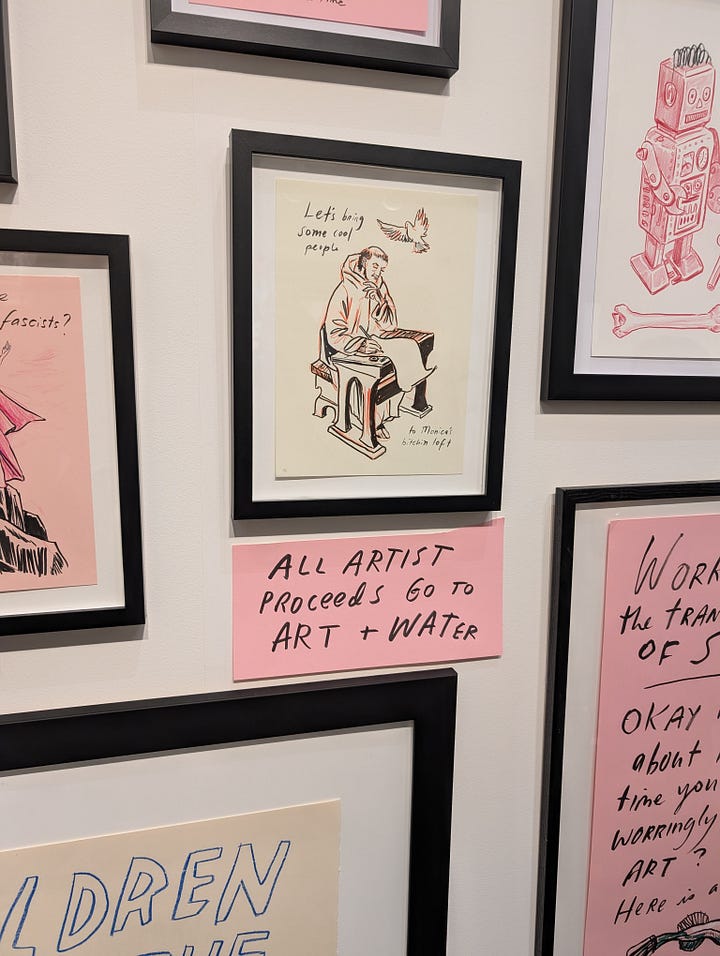
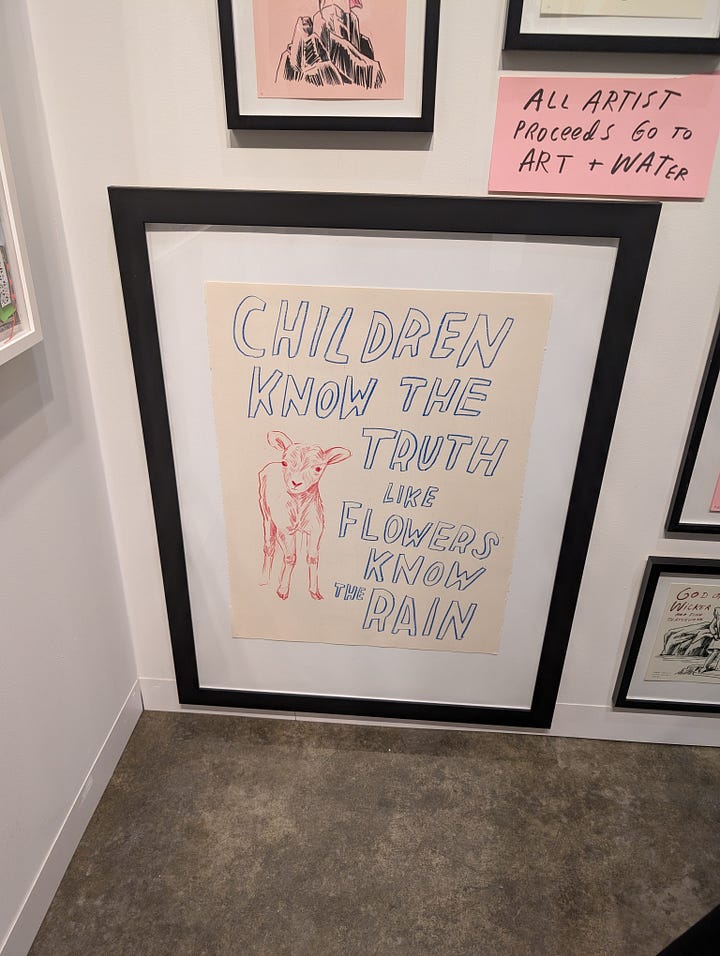
Down in the booths, at Cruise Control Contemporary from Cambria, Arthur Wechsler’s houses, islands, and sassy cats wear their soft, brushy hues like a kind of naïve honesty, though their affect is sweet, gentle, resolute, and unmistakably human. Electric Works had a salon-style hang of witty, Raymond Pettibon-ish works on paper by Dave Eggers, with the profits going to help jump-start Art + Water.
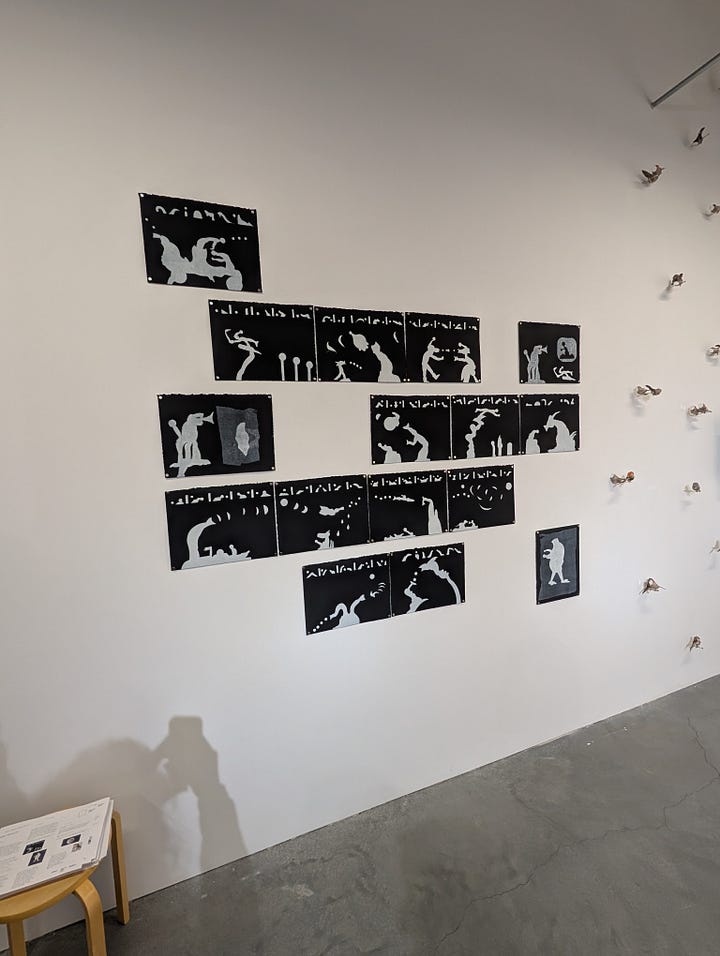
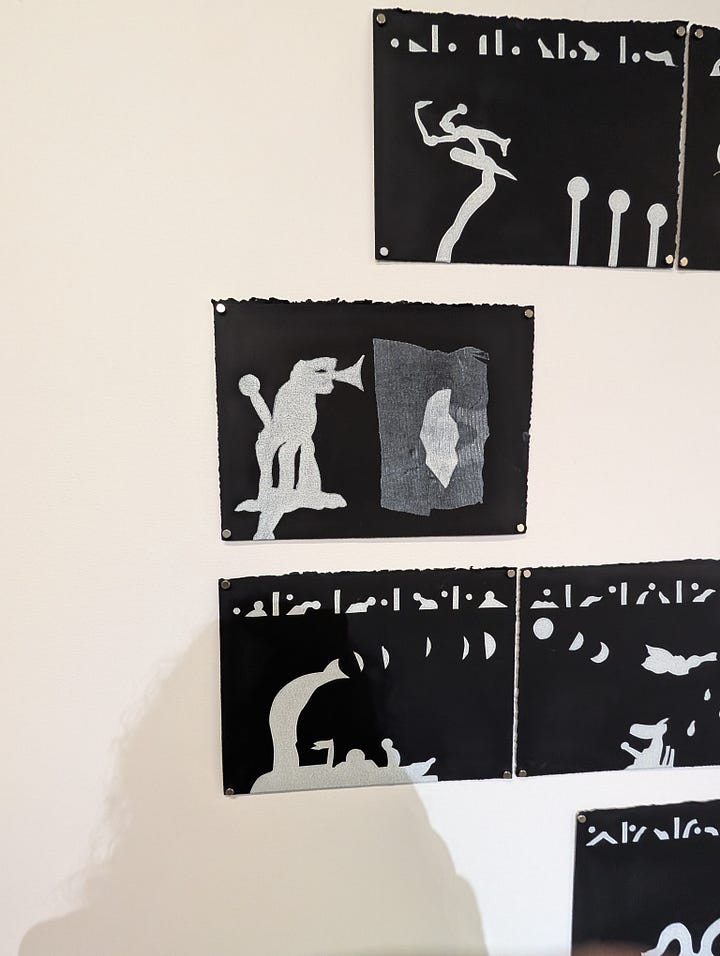
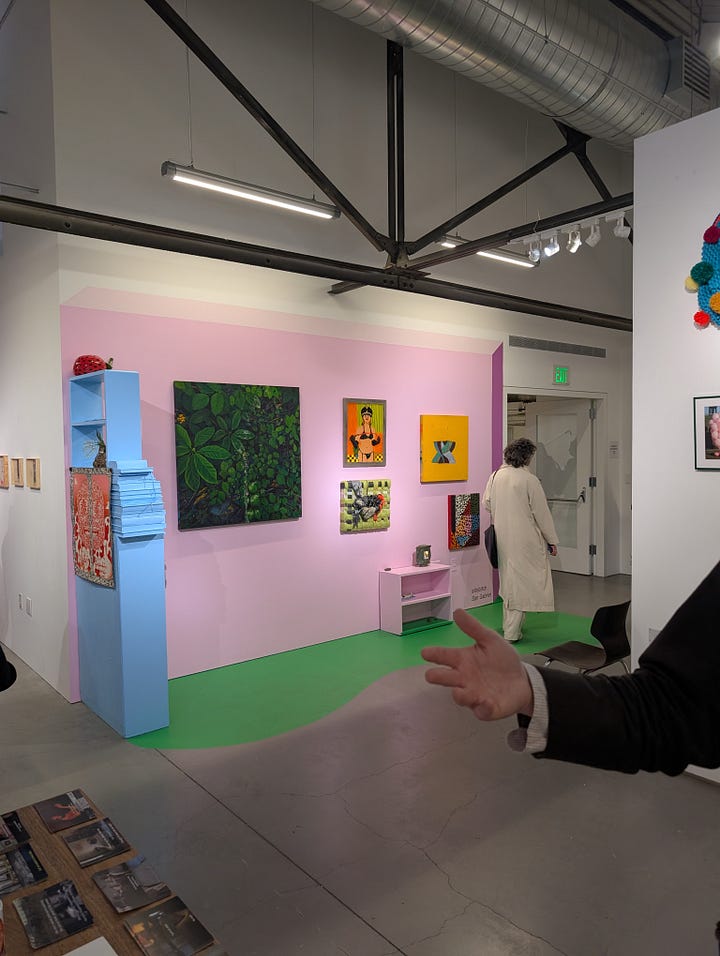
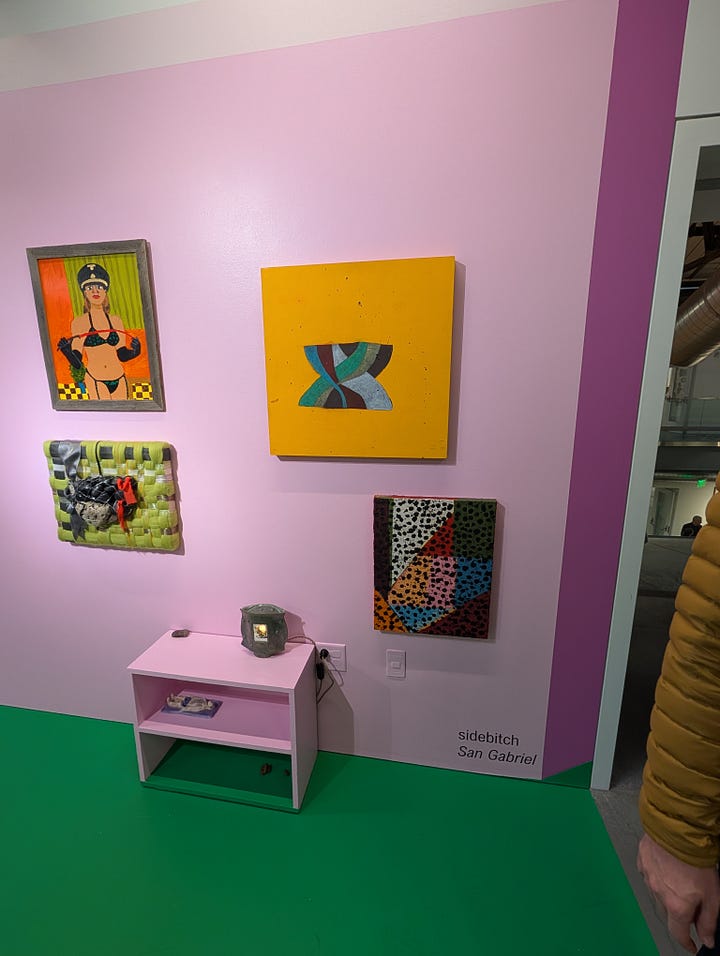
Upstairs in Skylight Above, with spaces invited and curated by Jonathan Runcio, the presentations refreshingly lacked booth partitions. Like Post-Fair in Los Angeles or certain incarnations of Sunday in London, it felt airy and open, and though each space had its own territory, the lack of wall demarcation made the whole thing more convivial. At Your Mood Projects, I lingered with artist Chris Johanson, learning about the shapely, modular, whimsical silhouettes of Lanford Weingrod, a retired pediatrician who developed their voice through decades of continuing education art classes at SFAI. Sidebitch’s presentation, visiting from Los Angeles, was gorgeous: a slick pink wall rising out of a green pool, with pink and sky-blue shelves holding a flamboyance of more petite works. On the walls, Chihiro Suzuki Hashimoto’s lush Pissing Contest II—piss squirting over dappled leaves—alongside Nick Aguayo’s spotfully angled abstraction. On the shelves, gently bendy clay figurines by Jose Joaquin Figueroa, a shimmering, plump ceramic strawberry by Kim Kyne Cohen, amongst many others. Altogether, a lovely frame for a delightful plenitude of artworks.
At FOG, I’d wandered through the familiar choreography: blue-chip names, five-figure price tags, gallerists in dark suits, artworks clearly framed as domestic objects and investments for the wealthy. Classy, sure, but transactional in that particular way international fairs are. ATRIUM felt different. Part food fair, part flea market, but also really and truly an art fair—approachable, but still totally serious and very good. Not a local pond grown stagnant without circulation, but a spirit and style that felt largely of a place. I saw and felt the Bay there.
International art fairs have their necessity and charm—the sheer force of talent, history, and variety of the international art world. Still, I may like the mode and method of ATRIUM better—not as a replacement, but as a homier way of supporting art, largely but not exclusively through the sale of art objects. ATRIUM is lovable.
With so many institutions and galleries falling and flailing under the pressures of affordability, understanding the conditions of art in San Francisco isn’t just a local report, but in truth, like much else of what this place makes—it’s a preview of the future. Those reworked stereographs by Sally Scopa held their double images: this obsolescent technology with one picture layered over another, both visible, neither quite resolving into three dimensions without the device. ATRIUM felt like that—a doubled image of what the art world has been and what it might become. We are in the aftermath of techno-capitalism, trying to find a way forward. This is one solution. Not localized stagnation, not a replacement for the international circuit, but homegrown, lovable. We are at a threshold of something different. A taste of San Francisco. A taste of what’s to come.
Andrew Berardini is a writer out of Los Angeles. He’s the co-founder and editor-in-chief of ArtBae.
Learn more about his work here: andrewberardini.com
